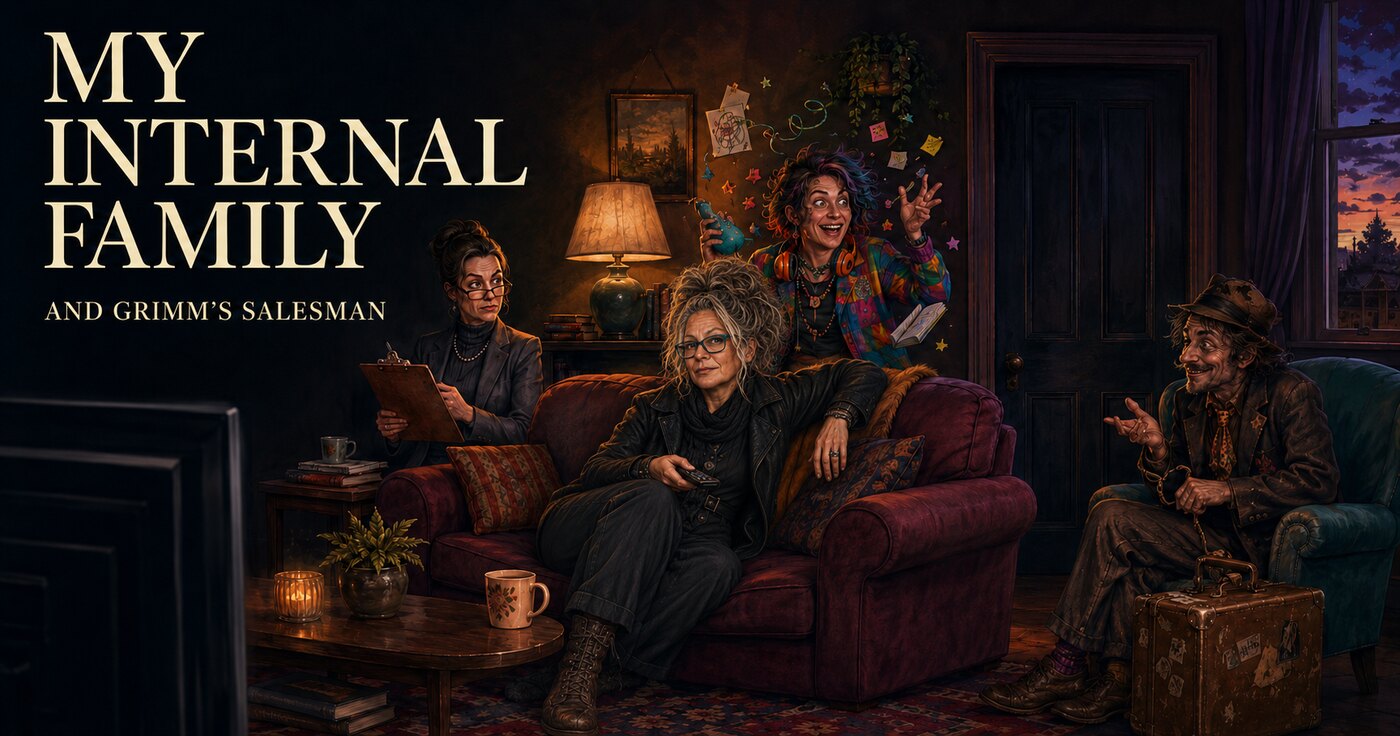
For years, I have described myself as having different personalities.
I do not mean that I have separate identities. I mean there are very distinct parts of me, each with its own personality, purpose and way of responding to the world.
Using the Internal Family Systems structure helped me begin to understand them. Instead of immediately asking, “What the hell is wrong with me now?” I could ask, “Which part of me is here, and what is it trying to do?”
My internal family has three main parts.
There is the Autism Critic Manager.
There is Chaos, which is my ADHD—the fighter and danger-facer.
Then there is the Exile, locked away and holding all the darkest emotions I cannot allow myself to release.
Now, I think I have identified a little extra person who occasionally turns up.
Grimm’s Salesman.
That is my depression.
The Autism Critic Manager
The Autism Critic Manager watches, analyses and tries to keep everything under control.
It examines what I do, what I say and how other people might interpret me. It checks whether I have behaved correctly, spoken too much, misunderstood something or somehow got being human wrong again.
This is the part that helped me build my masks.
It studied other people and learned what appeared to be expected of me. It created rules and coping mechanisms that allowed me to function in a world that rarely seemed designed for the way my brain works.
The Autism Critic Manager can be useful. It helps me notice details, recognise patterns, consider consequences and create some order inside my head.
It has also helped me hide how much I was struggling.
The trouble is that it can be bloody relentless.
It does not simply point out a possible mistake and move on. It can examine the same conversation repeatedly, searching for something I might have said or done wrong long after everybody else has forgotten the conversation even happened.
It believes that criticising me will prevent other people from doing it first. If it identifies every possible mistake, perhaps it can protect me from embarrassment, anger, rejection or abandonment.
Its methods can be cruel, but somewhere underneath them is an attempt to keep me safe.
Chaos—My ADHD
Chaos is my ADHD.
It is restless, impulsive, unpredictable and always looking for something to do. It can throw ten ideas into my head at once, begin an enormous project without considering how much work it will involve and make sitting still feel almost impossible.
Chaos can drag me in several directions at once. It can become completely absorbed in one thing and forget everything else exists. It can turn a simple task into an adventure, a crisis or sometimes both.
But Chaos is also my fighter and danger-facer.
When something frightening needs confronting, Chaos can run directly towards it. It gives me courage, energy and the ability to act while the Autism Critic Manager is still standing there with a clipboard, calculating every possible outcome.
Chaos has helped me survive.
It allows me to think quickly, find unusual solutions and keep fighting after other people might have given up. It can be brave, creative, determined and fiercely protective.
It can also react before the rest of me is ready.
Chaos may turn fear into action, anger or an impulsive decision. Sometimes it creates an even bigger mess while attempting to rescue me from the original one.
That does not make Chaos bad.
It is my ADHD, with all its exhausting complications and extraordinary strengths. It is difficult to control, particularly now that menopause has weakened many of the coping mechanisms I once relied upon.
But Chaos is not simply a problem that needs fixing.
It is also the part that faces danger.
The Exile Behind the Locked Door
Then there is the Exile.
The Exile is locked away because it holds all the dark emotions I cannot allow myself to release.
Pain, terror, grief, shame and everything else that has been pushed somewhere beyond my everyday reach—it is all kept behind that door.
I am frightened that if the Exile were ever allowed out completely, the weight of everything it carries would destroy me.
So the Autism Critic Manager manages.
Chaos fights.
And the Exile remains locked away.
Perhaps the other two work so hard partly because they know what is behind that door. They keep me functioning, moving and surviving so that I do not have to face everything the Exile carries all at once.
Recognising that the Exile exists does not mean I have to wrench open the door.
I do not need to release every dark emotion at once in the hope that it will magically make me better. Some doors need to be approached carefully, safely and with the right support.
For now, knowing the Exile is there helps me understand why the Autism Critic Manager and Chaos work as hard as they do.
They may be trying to protect me from what is locked away.
Then Menopause Took Away the Masks
For much of my life, I managed my autism and ADHD using coping mechanisms, routines and masks.
Some of those masks were so well practised that I did not even realise I was wearing them. I learned how to appear calmer than I felt, how to force myself through uncomfortable situations and how to behave in ways other people found acceptable.
It came at a cost, but it worked—sort of.
Then menopause arrived and appeared to take the entire system apart with a blunt screwdriver.
The coping mechanisms that once helped me function are no longer as reliable. The masks do not fit properly. Things I once forced myself to tolerate can now feel unbearable.
It is as if menopause has pushed my autism and ADHD right to the front and handed both of them a megaphone.
The noise is louder.
The overwhelm arrives faster.
My emotions sit closer to the surface.
My ability to tolerate demands, changes, people and general nonsense has become considerably smaller.
Social masking requires more energy, while recovering from it takes longer. Tasks I once completed through sheer force can suddenly feel enormous.
The Autism Critic Manager responds by attempting to control and analyse everything even more intensely.
Chaos becomes louder, faster and more difficult to contain.
Meanwhile, the Exile remains behind its locked door, holding everything I am still too frightened to release.
I am having to learn how to manage myself again.
That can be frustrating and frightening. Losing coping skills can feel like losing control, even when what is really happening is that the old methods no longer work for the person I am now.
Perhaps I will develop new coping skills.
Perhaps some of my masks were never particularly healthy and do not need replacing.
But living without them leaves me exposed. It means people may see more of my autism, more of my ADHD and more of the effort required to manage my internal family.
This is not me becoming difficult on purpose.
This is me trying to function after menopause rearranged the entire control room and neglected to leave an instruction manual.
My Revelation About Depression
I have had a revelation about depression.
I already recognise what it feels like when it arrives. It makes my body feel heavy and creates a horrible weight in the pit of my stomach. It makes everything seem dark and tries to convince me that nothing is worthwhile.
I can manage it by accepting that it has arrived and remembering that it will pass.
I roll myself up somewhere comfortable, get cosy and distract myself. I do not make important decisions while it is talking. I use the safety protocols I have already put in place and remind myself of the people who love me, the people I love and the people who reach out because they need me.
But now I have realised something else.
I should give my depression a name.
If recognising and naming my different internal parts has helped me understand them, perhaps naming depression will help me separate its voice from my own.
So I am calling it Grimm’s Salesman.
I picture him as a miserable little representative working for the Grim Reaper. He arrives carrying a battered suitcase full of lies and starts trying to sell them to me.
He tells me nothing is worth doing.
He tells me the darkness is permanent.
He tells me I am not needed.
He wants me to forget every person who loves me and every person whose life would be affected if I were no longer here.
But I know his sales pitch.
The next time he arrives, I can recognise him immediately.
I do not need to panic or wrestle with him. I do not even need to throw him out, because struggling with him might only make him louder.
I can tell him to shut up, go and sit in a chair and talk shit while I watch television.
He can jabber away in the background if he must. I will be busy distracting myself, following my safety protocols and waiting for him to leave.
I will not examine every ugly item in his suitcase.
I will not debate his arguments.
I will not believe a bloody word he says.
“You are not taking me. Go and sit in that chair and talk as much shit as you like. I am watching television, I am ignoring you and I know you will eventually piss off.”
Accepting that depression has arrived is not the same as surrendering to it.
It means recognising the visitor without giving him control of the house.
They Are Parts of Me, but They Are Not All of Me
Internal Family Systems helped me see my different parts more clearly.
The Autism Critic Manager analyses, organises, criticises and tries to protect me from making mistakes or being rejected.
Chaos is my ADHD—the impulsive, energetic fighter who runs towards danger and refuses to give up.
The Exile holds the darkest emotions I have not been able to carry consciously.
They can all be exhausting and difficult, especially now that menopause has disrupted the masks and coping mechanisms that once kept everything quieter.
But they belong to me.
They developed for reasons, and each has played some role in helping me survive.
Grimm’s Salesman is different.
He does not protect me. He appears when I am vulnerable and tries to sell me a permanent answer to temporary darkness.
But he does not get a vote.
Naming him means I can separate his jabbering from my own thoughts. I can fully recognise what he wants while refusing to give it to him.
I remember the people who love me. I remember the people I love. I remember those who reach out because they trust me and because my presence makes a difference in their lives.
I am needed.
I am loved.
I am still here.
The Autism Critic Manager might analyse that statement.
Chaos might want to fight somebody about it.
The Exile can remain safely behind its door.
And Grimm’s Salesman can sit in the corner talking shit to himself while I watch television.
He is not making a sale.
Think someone could use this?
If this made you think of someone, share it with them. Sometimes the right words find people at exactly the right time.
The Girl Who Split to Survive
The different parts of me did not appear for no reason. They developed while my mind was doing everything it could to help me survive experiences that were too much to hold all at once.
In The Girl Who Split to Survive, I tell the deeper story of that trauma, the ways my mind protected me and the woman I became afterwards.

Read Emma’s story
The Girl Who Split to Survive
A raw memoir about trauma, survival and the mind’s extraordinary ways of coping.
View the book on Amazon UKRecommended Reading: Internal Family Systems
This is the book behind the Internal Family Systems structure I used to understand my own parts.
Recommended book
Internal Family Systems Therapy
This comprehensive guide explains the complete Internal Family Systems model, including managers, firefighters, exiles and the Self. It helped give me a structure for recognising my different parts and understanding what each one was trying to do.
Stay for another one