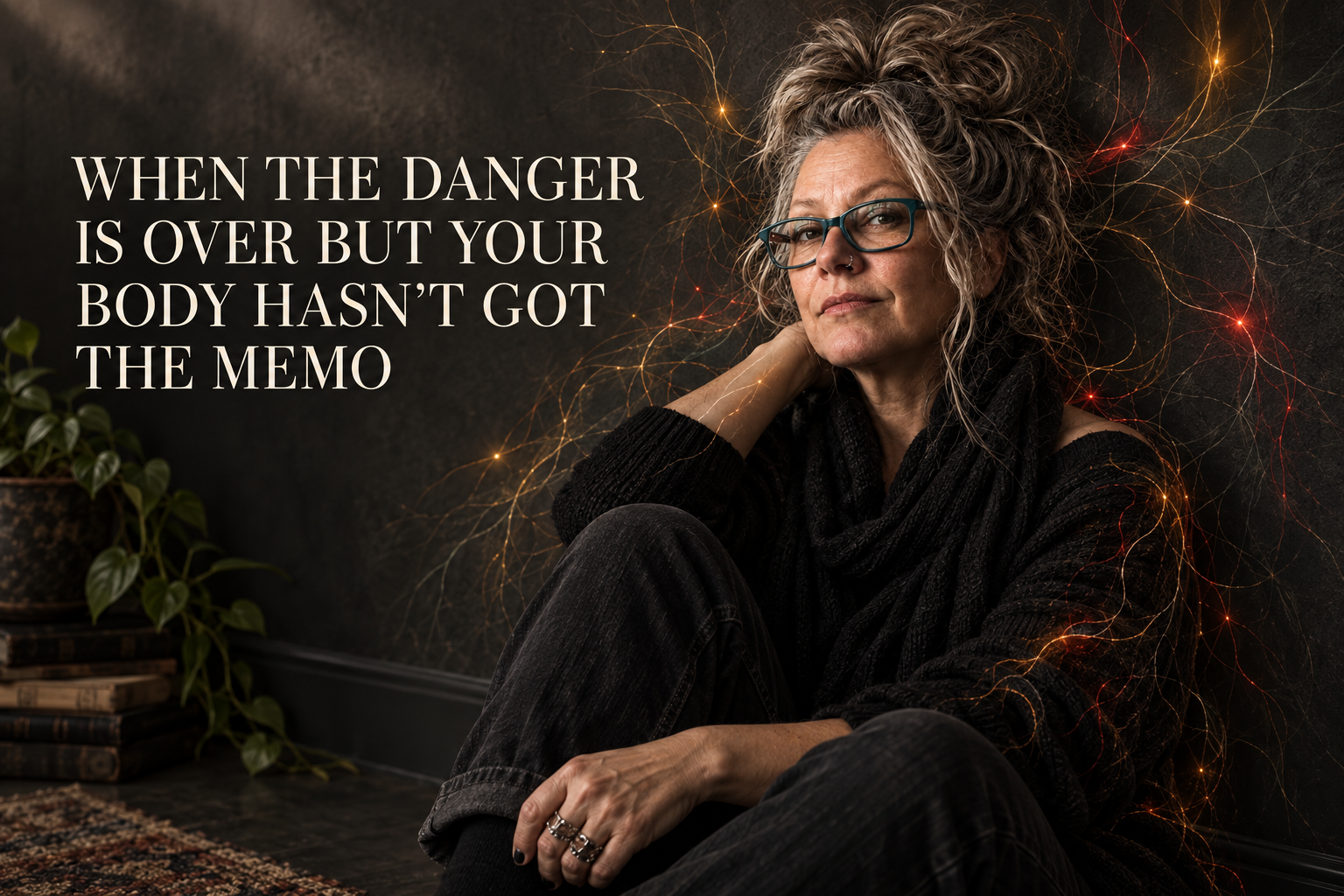
My body can turn an ordinary Tuesday into a full emergency drill without bothering to consult me first.
That is the infuriating thing about trauma: the danger may be over, while your jaw, shoulders, heart and stomach are still waiting for it to come through the door.
People often talk about trauma as though it lives only in the mind.
They picture memories, nightmares, flashbacks and fear. What they do not always picture is the aching jaw, the shoulders permanently braced for impact, the racing heart, the upset stomach, the headaches or the exhaustion.
Trauma can be emotional, but its effects can be painfully physical.
That does not mean every illness, pain or symptom is caused by trauma. Bodies are complicated little buggers, and new or persistent symptoms deserve proper medical attention. But it does mean that what happened to us can affect far more than our thoughts.
Sometimes the danger ends, but the body does not receive the message.
The Alarm System That Kept Us Alive
The human nervous system is designed to protect us.
When danger appears, it can prepare us to fight, run, freeze or shut down. Our heart may beat faster. Our breathing changes. Muscles tighten. Digestion becomes less important because survival has jumped to the top of the body's to-do list.
In a real emergency, this response is useful. It is ancient, quick and not interested in waiting for a committee meeting.
The trouble begins when the alarm keeps going after the danger has passed.
Trauma can leave a person feeling watchful even when they are safe. A sound, smell, facial expression, tone of voice, place or bodily sensation may trigger a reaction before the thinking part of the brain has worked out what is happening.
You may know perfectly well that you are standing in your own kitchen in 2026. Your body may still be responding as though you are back there, wherever there was.
That is not weakness. It is a protective system that learned its lesson too well.
What Trauma Can Feel Like in the Body
It is different for everybody, but trauma and prolonged stress can be linked with physical experiences such as:
- muscle tension, jaw clenching and body pain
- headaches or dizziness
- a racing heart, sweating, trembling or feeling easily startled
- stomach pain, nausea and digestive problems
- poor sleep, nightmares and waking exhausted
- breathlessness or tightness in the chest
- feeling restless, agitated or unable to settle
- fatigue, heaviness or complete shutdown
- difficulty concentrating or remembering things
- feeling disconnected from your body
Sometimes a person lives in high alert: tense, watchful and ready to react.
Sometimes the system drops in the other direction. Everything becomes heavy. Energy disappears. Thinking becomes difficult. The person may feel numb, detached or unable to begin even a simple task.
And sometimes the body bounces between the two, which is about as restful as being repeatedly thrown from a fire alarm into a power cut.
My Nervous System Has Gone Freelance
For me, none of this is an interesting theory printed in a textbook. I live in the practical demonstration.
Years of trauma have left my nervous system badly dysregulated, and my other medical conditions have joined in as though somebody advertised a group discount.
I have Mast Cell Activation Syndrome, or MCAS. Mast cells are part of the body's defence system and release chemical signals when they believe there is a threat. Mine appear to have misplaced the sensible operating instructions. The signalling has, in technical terms, gone a bit fucked.
My body can react as though something ordinary is an invading army. Allergy-type symptoms and sensitivities can arrive because the alarm system is far too enthusiastic and apparently has no indoor voice. Stress does not create every reaction, and MCAS is a genuine physical condition, but when my nervous system is already overloaded it can feel as though somebody has turned the sensitivity dial all the way up and then snapped the knob off.
Then there is Ehlers-Danlos syndrome, or EDS. Trauma did not give me EDS; it is an inherited connective-tissue condition. But living with a nervous system that is constantly braced for danger does not exactly help a body that already struggles to hold itself together properly.
My body has essentially gone into limp mode. My joints and supporting tissues are too loose, while my muscles work overtime trying to keep everything where the manufacturer presumably intended. The result is a ridiculous amount of pain. My skeleton is held together with determination, bad language and several complaints awaiting management review.
And because my body clearly felt this collection lacked ambition, I also have PoTS: postural tachycardia syndrome.
PoTS affects the autonomic nervous system—the automatic system that is supposed to handle useful background jobs such as heart rate and circulation without requiring a written request from me. When I become upright, my heart rate can rise abnormally and my body can struggle to adjust the circulation properly.
I experience presyncope, which is the unpleasant waiting room just before fainting. My strength disappears, my awareness starts fading and I can become semi-conscious. I call these my shutdowns. When one happens, I have to remain very still until my system decides to come back online.
Sometimes I need to get onto the floor quickly for safety because I may fall. If I am already down there, at least gravity has been outmanoeuvred.
You cannot fall off the floor. It may not be dignified, but dignity is wildly overrated when the alternative is introducing your face to the furniture.
From the outside it might look as though I am merely lying there doing nothing. Inside, my body is attempting the biological equivalent of switching itself off and on again.
This combination means I cannot neatly separate “mental” trauma from my physical body. The systems communicate with one another, sometimes badly and apparently in capital letters. Trauma is not the sole cause of all my conditions, but a nervous system trained by trauma to expect danger can make an already complicated body much harder to live in.
Humour helps me talk about it. It does not mean the pain, reactions or shutdowns are not serious. It just means I refuse to let every description of my life sound as though it should be read by a Victorian undertaker.
“But Nothing Is Happening Now”
This is one of the hardest parts to explain to people who have not experienced it.
Nothing may be happening now.
That does not mean nothing is happening inside the nervous system.
A trauma response is not always a clear memory arriving with a label attached. It may appear as irritation, panic, nausea, pain, exhaustion or an overwhelming need to escape. The trigger may seem ridiculously small because the present moment is only the spark. The fuel was laid down much earlier.
This is why telling somebody to “just calm down” is rarely the dazzling medical breakthrough people think it is.
The person may already be trying desperately to calm down. Their body simply has not caught up with the information that they are safe.
Trauma Is Not Always One Dramatic Event
Some trauma comes from a single terrifying event. Some comes from living for months or years in a situation where a person never felt safe.
It can come from abuse, neglect, violence, serious illness, loss, addiction, humiliation, instability or constantly having to judge another person's mood in order to stay out of danger.
When that happens in childhood, survival responses may become so familiar that they feel like personality.
The child who had to notice every change in the room may become the adult who cannot switch off.
The child who learnt that speaking made things worse may become the adult who freezes during confrontation.
The child who survived by becoming invisible may later wonder why being seen feels so frightening.
These were not character defects. They were adaptations. They helped somebody survive an environment they should never have had to survive.
But an adaptation that was brilliant then can become exhausting now.
When the Body Gets Blamed
People with trauma histories are sometimes made to feel that physical symptoms are imagined.
They are not imagined.
Stress responses are physical responses. Pain hurts. A pounding heart is real. A sleepless night is real. A stomach in knots is real. Exhaustion is real.
At the same time, it is important not to put every symptom into the trauma box and slam the lid. Trauma can affect the body, but it can also exist alongside medical conditions. Both deserve to be taken seriously.
“This may be connected to trauma” should open another door to care. It should never be used to close the medical one.
Recovery Is Not Simply Thinking Positively
You cannot bully a nervous system into feeling safe.
Recovery is often a slow process of giving the brain and body new evidence. Safe people. Safe places. Predictable routines. Boundaries. Rest. Honest conversations. Appropriate medical care. Trauma-informed therapy. Learning what triggers the alarm and what helps it settle.
Small grounding actions can sometimes help bring the body back into the present:
- looking around and naming where you are and what day it is
- noticing what you can see, hear and physically feel
- placing your feet firmly on the floor
- holding something cool, warm or textured
- gently lengthening the exhale without forcing the breath
- moving, stretching or walking if that feels safe for your body
- reminding yourself, “That happened then. I am here now.”
None of these is a magic trick. They are ways of offering the nervous system information it may not yet believe.
Therapy can help too, especially when it is with somebody who understands trauma and does not rush, dismiss or overwhelm you. Healing needs honesty, but it also needs safety. Digging into the past without enough support is not bravery; sometimes it is simply too much, too soon.
Your Body Is Not Betraying You
For a long time, people may hate their bodies for reacting.
Why am I tired again?
Why did that noise make me jump?
Why am I in pain?
Why can everybody else cope?
But perhaps the kinder question is: what is my body trying to protect me from?
The body is not always accurate about present danger, but it is not being dramatic for entertainment. It learnt patterns through experience. It is trying to keep us alive using information that may be years out of date.
We can learn to listen without letting every alarm control us.
We can have physical symptoms investigated while also recognising the role of stress and trauma.
We can stop calling ourselves lazy, weak, difficult or broken.
And slowly, repeatedly, we can show the body that life is not the same now.
The danger may be over.
Healing is helping the body believe it.
Think someone could use this?
If this made you think of someone, share it with them. Sometimes the right words find people at exactly the right time.
The Book That Opened My Eyes
Recommended reading
The Body Keeps the Score
This book was a real eye-opener for me. It helped me understand that trauma is not simply a horrible collection of memories stored in the brain. It can affect the way the whole body responds to the world. Suddenly, some of the reactions I had spent years blaming myself for began to make sense.
It did not magically fix anything—I am still waiting for the book that comes with a new nervous system taped to the back—but it gave me language for what I was experiencing. Sometimes understanding why your body is behaving like an unsupervised alarm panel is an important beginning.
The Girl Who Split to Survive
Where The Body Keeps the Score helped me understand the science and physical effects of trauma, The Girl Who Split to Survive tells the experience from the inside.
It is about what the mind may have to do when reality becomes too much, and how the ways we survived can remain with us long after the original danger has gone.
One helped me understand what trauma can do to the brain and body. The other is my account of what surviving it can actually feel like.

Read Emma's story
The Girl Who Split to Survive
A raw memoir about trauma, survival and the mind's extraordinary ways of coping.
View the book on Amazon UKReliable Information
This piece is my personal experience. For clinical information, visit the NHS guide to PTSD, NHS guide to PoTS, NHS guide to EDS and the NIMH guide to coping with traumatic events.
Stay for another one